Musk Proposes Training AI Models in Orbit Within 30 Months
Episode Summary
TOP NEWS HEADLINES Following yesterday's coverage of Google's $185 billion AI infrastructure commitment, Wall Street just wiped over a trillion dollars from Big Tech valuations on AI spending fear...
Full Transcript
TOP NEWS HEADLINES
Following yesterday's coverage of Google's $185 billion AI infrastructure commitment, Wall Street just wiped over a trillion dollars from Big Tech valuations on AI spending fears.
The market experienced one of its most dramatic reversals since May, with tech stocks rebounding 2.2% after the initial selloff.
Oracle took the hardest hit, dropping 42.8% over six months despite booking $523 billion in future contracts.
The UK High Court ruled that AI can't reliably conduct legal research after lawyers submitted 18 fake citations generated by ChatGPT.
But here's the twist: Anthropic just launched a legal plugin for Claude that improved 60% on complex legal benchmarks within weeks, causing legal software stocks to drop 8.5%.
The new USPTO Director is declaring AI patents "open for business." In his first four days on the job, he overturned part of a Google DeepMind AI patent rejection, signaling a major shift in how the patent office views AI innovations.
Amazon MGM Studios will launch a closed beta in March for AI production tools.
Season two of "House of David" already used 350 AI-generated shots, though this comes alongside roughly 30,000 layoffs since October.
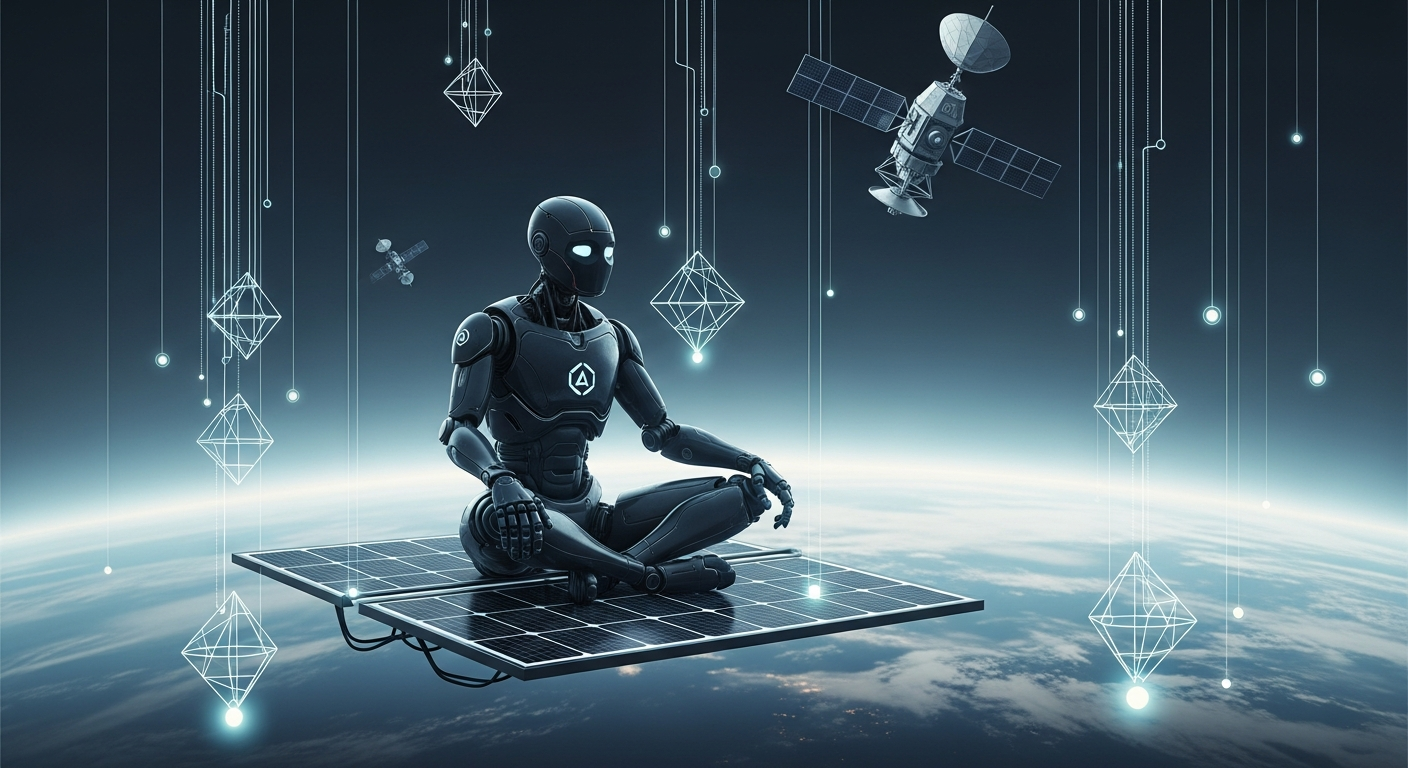
And the headline we'll dig into today: Elon Musk just proposed training AI models in orbit within 30 months, arguing that space will become the most economically compelling place for AI infrastructure.
Technical Deep Dive
In a three-hour interview on John Collison's podcast, Musk laid out why he merged SpaceX with xAI, and the technical argument is surprisingly straightforward. The entire United States uses about half a terawatt of power. Scaling AI to where it needs to go would require doubling that entire national energy output.
Meanwhile, chip production and demand are growing exponentially, but power generation outside China is essentially flat. Here's where space changes the equation. Solar panels in orbit produce roughly five times more power than ground-based installations.
There's no atmosphere blocking sunlight, no clouds, no nighttime, and batteries aren't required. Musk estimates space-based solar is effectively ten times cheaper than terrestrial alternatives when you account for all factors. The technical challenge isn't just getting solar panels into orbit.
It's creating an entire vertically integrated system: SpaceX launches the satellites, Tesla manufactures the solar panels, and xAI builds the AI models. Musk predicts that within five years, SpaceX will launch more AI compute annually than the cumulative total currently on Earth. This isn't just about circumventing power constraints.
It's about fundamentally reimagining where computation happens. The interview also revealed plans for TeraFab, a chip factory capable of producing over 100 million advanced chips annually, because if power is today's limiting factor, chips will be the bottleneck in five years.
Financial Analysis
The financial implications of this strategy are staggering. Musk is essentially betting his entire corporate empire on a single integrated thesis: that AI scaling will hit insurmountable physical limits on Earth. This explains why the merger between SpaceX and xAI wasn't just strategic collaboration but existential necessity.
Consider the capital intensity. Traditional data centers require massive investments in real estate, cooling infrastructure, and electrical grid connections. Natural gas turbines, the ideal power source for AI training, have manufacturers backordered through 2030.
Every major tech company is competing for the same finite resources. Google just committed $185 billion to AI infrastructure, and the market responded by wiping out a trillion dollars in value because investors suddenly realized the capital requirements might never generate proportional returns. Space-based infrastructure changes this calculation entirely.
The initial launch costs are enormous, but the operational economics are fundamentally different. No land acquisition costs, no property taxes, no utility bills in the traditional sense. The sun provides unlimited free energy, and cooling in the vacuum of space is actually easier than on Earth.
However, Musk acknowledged his timelines are, to put it diplomatically, optimistic. He pushes hard on limiting factors, which means the 30-month timeline should be technically possible, but there's significant execution risk. Wall Street has learned to add an "Elon multiplier" to his predictions.
Still, the underlying constraint he's identifying is very real, and whoever solves the power problem first will dominate the next phase of AI development.
Market Disruption
This strategy has massive implications for the current AI infrastructure race. Every major cloud provider, from Amazon to Microsoft to Google, has made enormous bets on terrestrial data centers. If Musk is even partially correct about space-based economics, these investments could become stranded assets within a decade.
China presents the most significant competitive threat. The country produces three times the electricity of the United States and controls 98% of global gallium refining, which is critical for high-end electronics. Musk's assessment was blunt: "We can't win on the human front, but we might have a shot on the robot front.
" This explains why the space strategy isn't just about AI training. It's about securing energy independence for the entire AI supply chain. The competitive moat here is nearly impossible for others to replicate.
Building a rocket company from scratch takes decades. Creating a car company with advanced manufacturing capabilities takes another decade. Developing cutting-edge AI models requires yet another set of rare competencies.
Musk has spent 20 years building the only vertically integrated company capable of executing this vision. Traditional cloud providers will need to decide quickly whether to partner with SpaceX or attempt to build their own space capabilities. Amazon has Blue Origin, but it's years behind SpaceX in launch cadence and cost efficiency.
Google and Microsoft have no space launch capabilities whatsoever. The window to catch up is closing rapidly.
Cultural & Social Impact
The cultural implications extend far beyond corporate strategy. Musk referenced the Kardashev scale, a framework proposed in 1964 that measures civilizations by their energy consumption. Type I civilizations harness all planetary energy.
Type II civilizations harness their star's entire output. Type III civilizations harness galactic energy. Humanity currently sits at about 0.
7 on this scale. Moving AI infrastructure to space represents humanity's first serious step toward becoming a Type II civilization. This isn't science fiction anymore.
It's engineering, manufacturing, and logistics. The fact that we're casually discussing training AI models in orbit within 30 months shows how rapidly our technological capabilities are advancing. There's also a fascinating parallel to the interview revelation about Optimus robots.
Building a humanoid hand required inventing custom actuators, motors, gears, and sensors from scratch because no existing supply chain exists. People who've lived in software, Musk noted, don't realize they're about to get a hard lesson in hardware. This observation applies equally to space infrastructure.
The AI industry has treated compute like an infinitely scalable cloud resource. Reality is about to intrude. For the general public, this shift might be almost invisible initially.
Your AI assistant won't care whether its model was trained on Earth or in orbit. But the geopolitical implications are profound. Whoever controls space-based infrastructure controls the future of artificial intelligence, which increasingly means controlling economic and military power globally.
Executive Action Plan
For business leaders, this development demands immediate strategic response. First, audit your AI infrastructure dependencies. If you're building on cloud platforms with exclusively terrestrial data centers, you're making a bet that Musk is wrong about space economics.
That might be the correct bet, but it should be a conscious decision, not a default assumption. Consider diversifying your infrastructure partnerships to include companies with clear paths to space-based compute. Second, reconsider your energy strategy holistically.
The companies that will thrive in the next decade aren't just those with the best AI models. They're the ones with secured access to power. This might mean long-term contracts with utilities, investments in on-site generation, or partnerships with companies developing space-based infrastructure.
The chip shortage of 2021 taught us that hardware constraints can cripple software businesses. The power constraint will be more severe and longer-lasting. Third, pay attention to the vertical integration trend.
Musk's strategy works because SpaceX, Tesla, and xAI are now one integrated system. You may not need to build rocket companies, but you should identify your critical dependencies and consider whether vertical integration makes strategic sense. The companies that control their entire stack, from power generation to chip manufacturing to model training, will have enormous advantages over those dependent on third-party infrastructure.
Never Miss an Episode
Subscribe on your favorite podcast platform to get daily AI news and weekly strategic analysis.