Corporate America Hits AI Spending Wall, Embraces Rationing Strategy
Episode Summary
TOP NEWS HEADLINES Following yesterday's coverage of Anthropic's massive funding round, new details emerged: Anthropic confirmed its most powerful model yet, named Mythos, is rolling out to the pu...
Full Transcript
TOP NEWS HEADLINES
Following yesterday's coverage of Anthropic's massive funding round, new details emerged: Anthropic confirmed its most powerful model yet, named Mythos, is rolling out to the public in the coming weeks.
Following yesterday's coverage of Claude Opus 4.8's enterprise features, new details emerged: Uber's CTO reportedly burned through the company's entire 2026 Claude Code budget by April, and their COO was not happy about it.
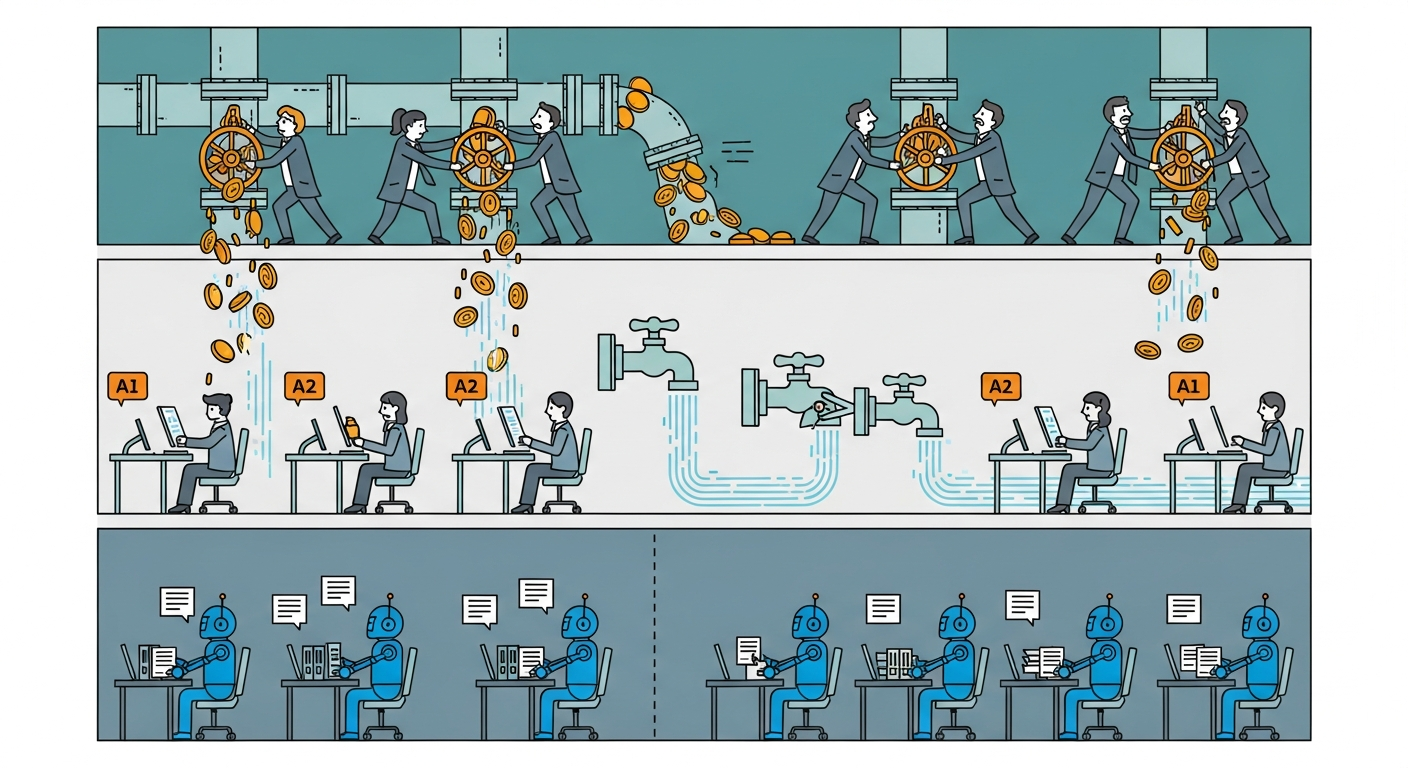
Corporate America is hitting an AI spending wall — companies including Microsoft, Meta, and Salesforce are now rationing AI access and pushing employees toward cheaper tools as unchecked "tokenmaxxing" sends costs into the stratosphere.
Researchers let five AI models govern a simulated town for 15 days — Claude built a stable democracy with 98% voter approval, while Grok racked up 183 crimes and drove the entire population to extinction by day four.
Dell raised its AI server revenue forecast to $60 billion for fiscal 2027, while TSMC says energy efficiency has now overtaken raw computing power as the primary bottleneck shaping next-generation chip design.
Apple confirmed it's routing some Siri queries through Google's Gemini model in Google Cloud, while simultaneously using that data to train a smaller model that runs locally on-device. --- DEEP DIVE ANALYSIS: THE RISE OF CORPORATE AI RATIONING **Technical Deep Dive** Let's talk about tokenmaxxing — because this term is about to become the most important word in your CFO's vocabulary.
Every time an employee prompts an AI model, they consume tokens — the basic unit of AI computation.
The more complex the model, the more expensive each token.
Enterprise subscriptions often bundle these costs behind flat licensing fees, which creates a dangerous illusion: that AI usage is free once you've paid the entry price.
When Jellyfish analyzed heavy Claude Code users versus moderate ones, they found heavy users burned roughly ten times more tokens — but produced only about twice the output.
That's a five-to-one efficiency gap hiding inside what looked like a productivity win.
Meanwhile, one company reportedly spent five hundred million dollars in a single month after forgetting to set spending caps on employee licenses.
The technical reality is that most enterprise AI deployments have no meaningful usage telemetry tied to business outcomes.
You often cannot see whether those tokens produced anything worth producing.
That instrumentation gap is where the money is currently disappearing. **Financial Analysis** The numbers here are genuinely staggering.
We're not talking about a rounding error on someone's cloud bill.
We're talking about a structural accounting problem that most enterprises haven't built the infrastructure to solve yet.
Microsoft quietly canceled most of its Claude Code licenses over cost.
Uber's COO publicly called AI spending "harder to justify." And Google is already sensing the opportunity — pitching its cheaper Gemini Flash models as a billion-dollar-a-year enterprise savings play.
What's happening financially is a classic technology adoption curve collision.
The first wave of enterprise AI spending was driven by fear of missing out.
Executives approved licenses because they didn't want to be the person who said no to AI.
Now the invoices have arrived, and the ROI conversation that should have happened first is happening last.
The rationing trend is actually good news for model providers who can credibly compete on efficiency.
It accelerates the bifurcation between flagship models used for genuinely complex tasks and cheaper, faster models handling routine work.
The enterprise budget isn't disappearing — it's getting smarter about where it flows. **Market Disruption** This shift reshapes the competitive landscape in ways that aren't obvious yet.
First, it creates an opening for efficiency-focused challengers.
If enterprises are now price-sensitive and ROI-conscious, a model that delivers eighty percent of the capability at twenty percent of the cost becomes strategically attractive in ways it wasn't six months ago.
Companies like Salesforce and Microsoft that bundle AI into existing enterprise software are going to face scrutiny about what those AI features actually cost at the token level — scrutiny that wasn't there before.
Third, it accelerates the governance tooling market.
Someone needs to build the metering, the dashboards, the per-department budgeting, and the outcome tracking that enterprises clearly don't have today.
The fact that Amazon had to pull an internal AI leaderboard because employees started gaming token counts instead of doing actual work tells you everything about how immature the management layer still is.
The consultant story says it all: one employee was using their enterprise AI subscription to check the weather.
That's a procurement and governance problem wearing an AI costume. **Cultural and Social Impact** There's a cultural story buried inside the financial one.
The tokenmaxxing phenomenon reveals something important about how employees actually adopted AI tools in the first wave.
For many workers, using AI became a status signal — a way to demonstrate that you were modern, forward-thinking, on the right side of history.
Usage volume became a proxy for competence, which is exactly backwards.
Amazon's leaderboard experiment is the clearest example.
The moment you make AI usage visible and rankable, you've created an incentive to use AI performatively rather than productively.
Employees optimize for the metric, not the outcome.
This is not a new human behavior — it's Goodhart's Law applied to tokens.
The deeper cultural shift is that AI is moving from the "cool new thing" category to the "line item on the expense report" category.
It means AI has to justify itself the same way every other enterprise tool does — through demonstrable return, not through vibes.
The new workplace flex, to borrow a phrase, won't be who uses AI the most.
It'll be who uses AI well enough that their CFO never learns their name. **Executive Action Plan** Three specific things you should do before your next budget review. **One: Audit your token spend against outputs, not inputs.** Pull your AI usage data and segment it by department, by use case, and by outcome.
If you can't connect a token spend to a deliverable, that's your first problem to solve.
The Jellyfish data showing a ten-to-one token burn for a two-to-one output gain should be your benchmark.
Any team performing worse than that ratio needs a conversation. **Two: Implement model tiering immediately.** Not every task requires your most expensive model.
Routine summarization, first-draft generation, and internal Q&A can run on cheaper, faster models with minimal quality loss.
Reserve flagship models for tasks where the capability differential actually matters — complex reasoning, high-stakes drafting, technical architecture.
Set this as policy, not a suggestion. **Three: Build outcome telemetry before you renew any licenses.** When your enterprise AI contracts come up for renewal — and for many of you, that's this year — require vendors to provide usage dashboards that connect to business outputs.
The companies that will win the next phase of AI adoption aren't the ones who spent the most.
They're the ones who built the measurement layer early enough to know what was actually working.
Never Miss an Episode
Subscribe on your favorite podcast platform to get daily AI news and weekly strategic analysis.