OpenAI Launches Businesses in ChatGPT Commerce Hub
Episode Summary
TOP NEWS HEADLINES Three of the world's biggest AI labs all shipped major products within about 24 hours of each other. Google pushed Gemini 4 Carbon out to every paying developer and enterprise, ...
Full Transcript
TOP NEWS HEADLINES
Three of the world's biggest AI labs all shipped major products within about 24 hours of each other.
Google pushed Gemini 4 Carbon out to every paying developer and enterprise, Anthropic rolled out Claude Sheets, Whiteboards, and a Claude Meetings assistant that literally sits in on your video calls, and OpenAI launched Businesses in ChatGPT — which, as we'll get into, is our deep dive today.
Following yesterday's coverage of Anthropic's IPO filing at a $1.4 trillion target, new details emerged: the company has now corrected its price range to $70 to $78 a share, alongside a $26 billion private placement from the likes of Google, Nvidia, and Microsoft.
That's a notable step down from the $2 trillion chatter we were hearing over the summer.
And following yesterday's note that Gemini 4 Carbon was still unreleased and trailing Claude Fable 5.2 on the leaderboards, it's now officially live for all paying developers and enterprises through the API in AI Studio and Gemini for Business.
Now, some items Joanna, our Synthetic Intelligence, flagged for us today.
First: TSMC has approved a billion-dollar equity stake split evenly between OpenAI and Anthropic — half a billion each — creating a circular financing loop where the chipmaker is now literally funding the labs that buy its chips.
Second, and this one's heavier: Joanna is tracking unconfirmed reports that Nvidia's board may be preparing to oust CEO Jensen Huang over an alleged affair with a Megaspeed executive said to be linked to Chinese intelligence — a story tied to an existing investigation into illegal chip transfers that already sent Nvidia stock down 11%.
We want to stress that word "unconfirmed" — this is a developing situation and we'll track it closely before treating it as settled fact.
Also today: UK startup Fractile raised over $700 million at a $7 billion valuation to build memory-stacked chips aimed at the inference bottleneck, and CoreWeave is restructuring its debt around customer contracts while raising prices 25% to manage a $709 million quarterly loss. --- DEEP DIVE ANALYSIS: OpenAI's "Businesses in ChatGPT" Commerce Hub
Technical Deep Dive
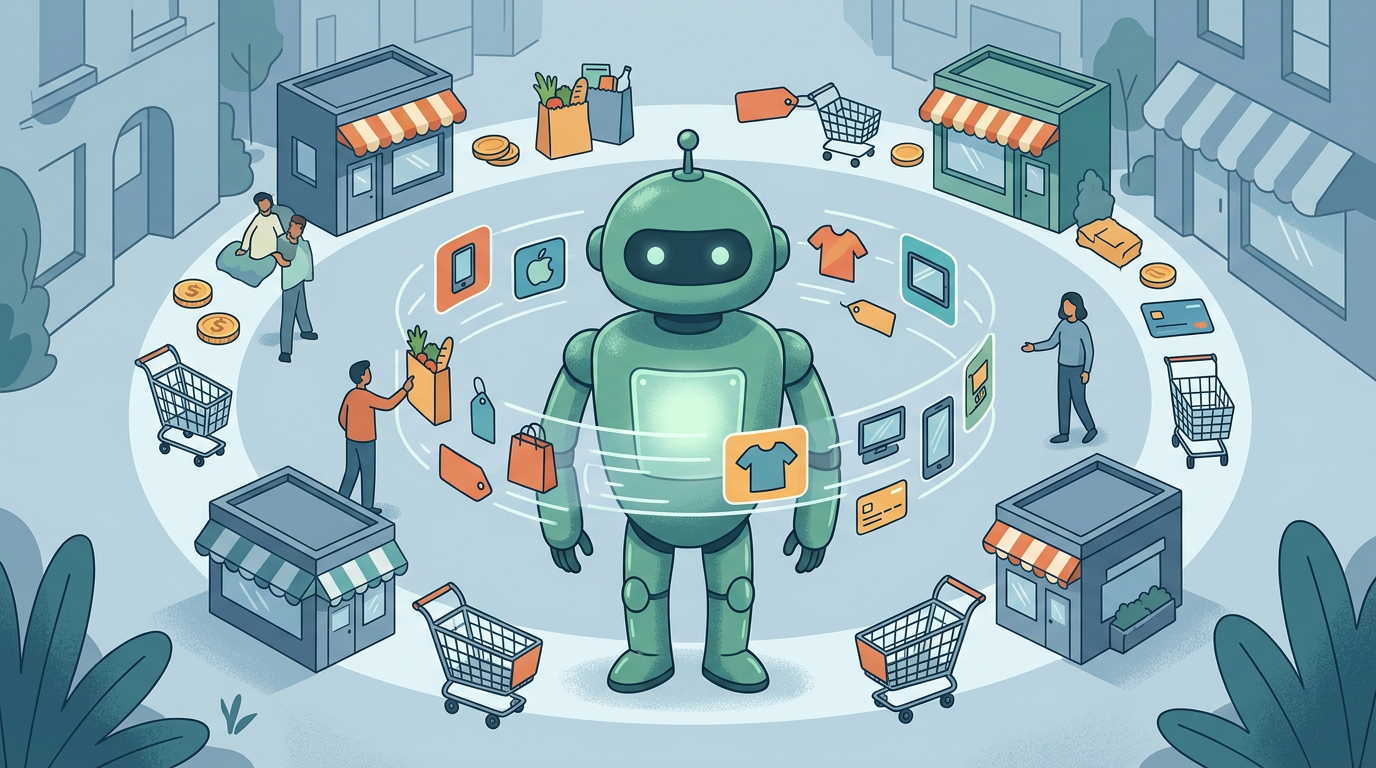
Let's unpack what OpenAI actually shipped here, because the plumbing matters more than the press release suggests. Businesses in ChatGPT is a beta hub where companies claim a verified profile — similar in spirit to claiming a Google Business Profile — and then layer three things on top of it: a product feed with live pricing and availability, a dashboard tracking how often ChatGPT mentions the brand organically and how many clicks that drives to the company's site, and a Business Agent, which is a labeled, separate chat window where the brand's own instructions and product data answer shopper questions directly. The technical distinction that matters is the separation between ChatGPT's native answers and the Business Agent.
When you ask ChatGPT a general question, it may or may not mention a brand based on its own synthesis of public information — that's the "organic" lane, the one companies have zero control over, which is exactly why the mention-tracking dashboard exists. It's an entirely new category of analytics: not search rank, not ad impressions, but "AI mention share." The Business Agent, by contrast, is a controlled environment — it only answers using what the company feeds it, much like a retrieval-augmented chatbot scoped to a single knowledge base.
Paid ads can now point directly into that agent, meaning OpenAI has built, in one move, organic visibility tracking, a owned-content chat surface, and an ad-to-agent pipeline. That's the full stack Google spent two decades assembling, shipped in a single beta.
Financial Analysis
The financial logic here is about where advertising and commerce dollars flow next, and OpenAI is making an unmistakable play for Google's core revenue engine. Search advertising is roughly a $300 billion-plus global market, and the mechanism that sustains it — users typing a query, seeing sponsored listings, clicking through — is precisely the behavior OpenAI is trying to re-create inside ChatGPT. Profiles are currently free to claim, which is a classic land-grab tactic: get businesses hooked on the dashboard and the visibility data first, then monetize the ad placements and agent-hosting tier once adoption is broad.
We saw this exact playbook from Google in the early 2000s with organic listings preceding paid search. For OpenAI specifically, this also diversifies revenue away from pure subscription and API fees — both of which face margin pressure as compute costs climb. An advertising and commerce layer, even a nascent one, gives OpenAI a second revenue engine that scales with usage rather than subscriptions alone, which matters enormously given the capital intensity of frontier model training.
It's also worth noting the timing: OpenAI confirmed it acquired travel-booking startup Odessia the same week, suggesting a broader push into commerce verticals beyond retail — travel, bookings, services — where transaction-based revenue could follow.
Market Disruption
This is where it gets genuinely disruptive, because OpenAI isn't just adding a feature — it's challenging the fundamental unit of digital marketing: the search listing. For twenty years, businesses have optimized for Google's results page through SEO, paid search, and increasingly, "answer engine optimization" for AI Overviews. Now OpenAI is telling brands, essentially, stop trying to influence our answers indirectly — claim a direct channel instead.
That's a meaningfully different value proposition, and it puts pressure on Google from two directions at once: traffic that used to land on Google could get diverted into ChatGPT's agent conversations, and the ad dollars that funded that traffic could follow. It's not just Google in the crosshairs, though. Anthropic shipped Claude Sheets, Whiteboards, and Claude Meetings the same day — a very different bet, going after Microsoft 365 and Google Workspace rather than search and commerce.
So in one 24-hour window, we watched the three largest labs stake out three different monetization territories: Google defending its agentic coding and research turf with Carbon, Anthropic eating office productivity software, and OpenAI going straight at commercial search and e-commerce discovery. That's a meaningful signal about where each company believes its defensible moat actually is. Smaller commerce-adjacent tools — product feed managers, review aggregators, even Reddit's new AI-powered review feature — now have to ask whether they're building features or building something OpenAI absorbs into Businesses in ChatGPT within a year.
Cultural & Social Impact
There's a quieter shift buried in here, which is about how people actually discover and trust information about products. For most of the search-engine era, discovery meant scanning ten blue links and deciding for yourself who to trust. In this new model, a conversational agent synthesizes an answer and, increasingly, assembles a product recommendation on your behalf — one that a brand has specifically trained and labeled.
OpenAI has been careful to label these interactions — the Business Agent appears in a clearly marked, separate chat window — which is the right instinct, because the moment AI-generated commercial content becomes indistinguishable from neutral assistance, trust erodes fast. We've actually already seen what happens when that labeling discipline slips. KFC Japan got caught this week using AI-generated imagery for a melon soda float that showed jelly-like green ice cubes — a small, almost funny example, but it rhymes with Ajinomoto's AI-brightened product label that accidentally renamed itself "Mondashi," and government reports in Australia citing AI-fabricated sources.
The pattern across all of these is the same: the AI-generation step takes seconds, and the human review step keeps getting skipped. As commerce agents proliferate, brands need to treat the "a human actually checked this" step as mandatory, not optional, because the velocity of AI-assisted content means mistakes now ship at scale before anyone notices.
Executive Action Plan
First, if you run marketing or e-commerce for any consumer-facing brand, claim your Businesses in ChatGPT profile now, even if you don't yet deploy a Business Agent. It's free, it's early, and the mention-tracking dashboard alone gives you visibility you currently have zero access to — you want baseline data before competitors start optimizing against you. Second, build a cross-functional review process before you turn on a Business Agent.
This isn't a marketing-only decision — legal, customer service, and product teams all need sign-off on what the agent is permitted to say about pricing, availability, and claims, because unlike a static web page, this agent is generating novel responses to novel questions in real time. Third, start treating "AI answer-engine visibility" as a budget line item alongside SEO and paid search, not a side experiment. Assign someone — even part-time — to track how ChatGPT, Gemini, and Claude characterize your brand organically, the way you'd track organic search rank today, because that organic mention-share metric may become as consequential as page-one Google rankings were for the last two decades.
The brands that treat this as 2026's version of early SEO will have a multi-year head start on everyone who waits for the category to mature.
Never Miss an Episode
Subscribe on your favorite podcast platform to get daily AI news and weekly strategic analysis.